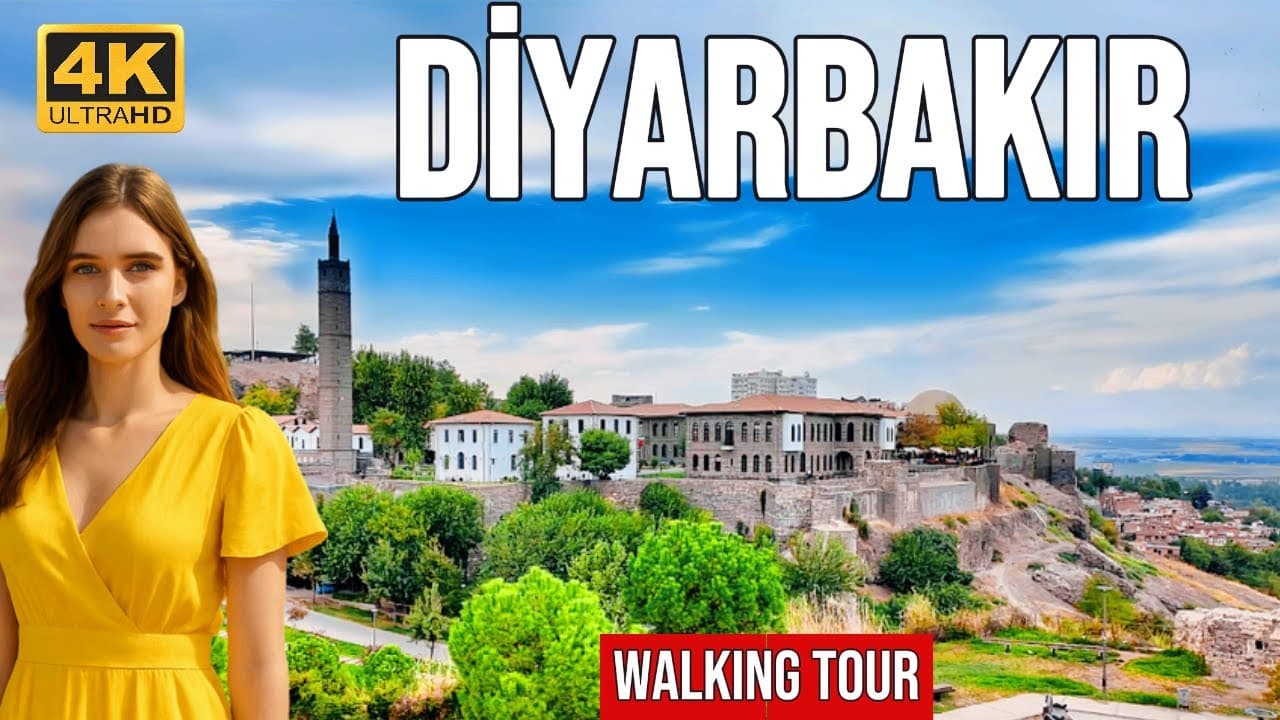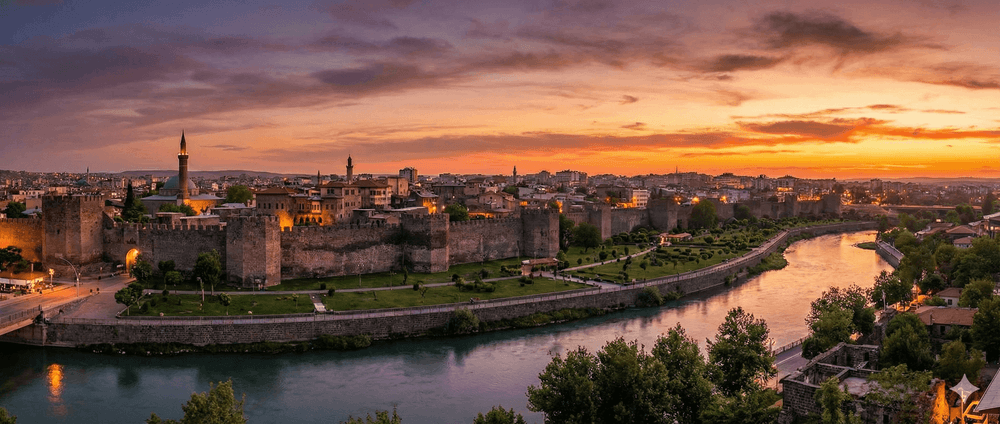
Plan Diyarbakir around its black basalt walls, the Great Mosque, the historic hans, the Cemil Pasha mansion, the Ten-Eyed Bridge and the Hevsel Gardens.
Walk this route
Diyarbakir's Hidden Gems: Off the Beaten Path Walking Tour 4k 60fps | Turkey Walking Tour
Watch the 4K walkPlaces on the map
13 pinsNumbers match the order in the article. Tap a pin for directions.
The city of black basalt walls above the Tigris: Diyarbakir
The first thing that stays with you in Diyarbakir is the walls. Huge ramparts built from black basalt rise above the Tigris and wrap around the old city, carrying a story thousands of years old. Diyarbakir is one of the oldest settlements in south-eastern Anatolia. Hurrians, Assyrians, Romans, Byzantines, Arabs, Seljuks and Ottomans all passed through, and each left a mark in the stone.
This is not a museum city. It is a living one. Inside the walls the mosques are still open for prayer, people eat breakfast in the courtyards of old hans, and daily life fills the narrow streets. If you try to rush through, you miss most of it. Diyarbakir rewards slow walking, sitting in courtyards, and looking without hurry.
The most common mistake is coming in the middle of summer, in the midday heat. Diyarbakir summers are very hot and the basalt holds the sun. The second mistake is rushing the old city. Instead of trying to see everything in one afternoon, set out early in the morning and give the city time.
Quick answer
Diyarbakir is a historic walled old city (Sur) ringed by black basalt walls above the Tigris, and it is best visited in spring or autumn, early in the morning.
- Two full days: one inside the walls, one for the Tigris valley and the day trips.
- The walls and the Hevsel Gardens are on the UNESCO World Heritage list; walk sections of the ramparts rather than trying to circle them all.
- Mosques and shrines are active places of worship: dress modestly and avoid prayer times.
1. The Diyarbakir city walls
The walls are among the longest surviving fortification systems anywhere, running roughly five and a half kilometres around the old city in black basalt that turns almost blue in low sun. What stands today is largely Roman and Byzantine work rebuilt many times, studded with dozens of towers and pierced by four main gates: Mardin, Urfa, Dağ and Yenikapı. Inscriptions and carved reliefs from a dozen eras cover the stone, which is why the walls, together with the Hevsel Gardens, carry a UNESCO World Heritage listing. Some stretches can be walked on top; access changes with restoration work, so verify which sections are open before you plan a route. Do the walls early or late, when the heat drops and the basalt takes colour. Watch your footing on the ramparts, since railings are inconsistent.
2. The Great Mosque of Diyarbakir
The Ulu Cami is one of the oldest mosques in Anatolia, rebuilt in the late 11th century by the Seljuk sultan Malik-Shah on a site that had already served as a church and, before that, a Roman temple precinct. That layering is visible everywhere: classical columns and carved capitals stand reused in the arcades, and the courtyard reads more like a Roman forum than a typical Ottoman mosque. It sits at the physical and social centre of the walled city, and its courtyard works as the old town's living room, with men on benches, students crossing to the medreses, and traders cutting through. It remains an active mosque: cover shoulders and knees, women cover their hair inside, remove shoes, and stay outside during the five daily prayers. Entry is free.
3. The Four-Legged Minaret
A few streets from the Great Mosque stands the Şeyh Mutahhar Mosque and its famous minaret, which rests not on a wall but on four short basalt columns, leaving an open passage beneath it. Local custom says walking under it seven times brings a wish, and you will often see people doing exactly that. The structure dates to the late 15th century, under the Akkoyunlu, and the columns are as slender as they look, which is why the minaret has needed repeated restoration. The lane around it is ordinary, working old-city street, which makes the sight better rather than worse: it belongs to the neighbourhood, not to a ticketed circuit. Two minutes on foot from the Ulu Cami, and free to see at any hour.
4. Hasan Pasha Han
Directly across from the Great Mosque stands Hasan Paşa Hanı, a 16th-century Ottoman caravanserai of black and white banded stone built around a broad arcaded courtyard. Where merchants once stabled animals, the ground floor now holds the city's best-known breakfast courtyard, and it is genuinely worth doing: kaymak, honey, local cheeses, sac böreği and endless tea under the arches. Weekend mornings are packed and slow, weekdays are calmer. The upper gallery holds craft and jewellery shops, some pushy, most fine. Prices are posted; a full breakfast for two is a real meal, so come hungry and expect it to take an hour. Even without eating, walk into the courtyard for the architecture: this is the best-preserved han interior in the city.
5. Suluklu Han
Sülüklü Han is the quieter, smaller counterpart to Hasan Paşa, a restored basalt han whose courtyard now works as a cafe and evening gathering spot rather than a breakfast machine. The name refers to leeches once sold here for medicine, one of those details that tells you what a caravanserai actually was: a marketplace as much as a hotel. Restoration has been careful, and the shaded courtyard is a good place to sit out the worst of the afternoon heat with tea or coffee when the streets are unbearable. It fills with a younger local crowd in the evening. Free to enter and wander; you only pay if you order something. It is a short walk from the Ulu Cami through the bazaar lanes.
6. Deliller Han
Near the Mardin Gate at the southern end of the walled city stands Deliller Hanı, built in the 1520s as a caravanserai for the guides, the delil, who led pilgrims onward toward Mecca. It is the largest han in the city, two storeys of arcades around a wide courtyard in the same black basalt. Today it operates as a hotel, but the courtyard is generally open to visitors, and stepping in for a look or a tea is normal and welcome. The scale gives you a clear sense of how much traffic passed through this city on the pilgrimage and trade routes. It pairs naturally with the Mardin Gate and the walk out toward the Ten-Eyed Bridge, since all three sit within a few hundred metres.
7. The Cemil Pasha Mansion and the Dengbej House
Cemil Paşa Konağı is a restored 19th-century basalt mansion, now the city museum, and it shows how the old Diyarbakir house worked: rooms arranged around a courtyard with a pool, a summer side and a winter side, thick stone against the heat. The displays cover local crafts, dress and daily life. Nearby, the Dengbêj Evi keeps something rarer alive: the dengbêj are Kurdish oral bards who carry long sung narratives, and older singers gather in the courtyard to perform for whoever sits down. There is no ticket and no schedule to rely on, so treat it as luck rather than a booking; when it happens it is the most memorable half hour in the city. Listen quietly, and ask before recording or photographing the singers.
8. The Ten-Eyed Bridge
The On Gözlü Köprü carries the old road across the Tigris below the southern walls, and an inscription dates it to 1065, under the Marwanids. Ten low basalt arches step across the river, and the bridge still stands where the city has always crossed. Come at the end of the day: the light on the water, the walls rising behind, and the Hevsel Gardens spread green along the bank make this the classic Diyarbakir view. It is a short taxi ride or a long walk from the Mardin Gate down the slope, and there is no ticket. The riverbank around it is casual, local space rather than a landscaped park; families picnic here in the cooler hours.
9. The Hevsel Gardens
Between the walls and the Tigris lies a strip of market gardens that has been cultivated for something like eight thousand years, feeding the city from the same fields since antiquity. That continuity is why the Hevsel Gardens share the UNESCO listing with the walls: they are the reason a city exists on this bluff at all. From above, on the ramparts or the Fiskaya terrace, they read as a wide green shelf against the black stone. Down at ground level they are working farmland, not a park, so there is no visitor circuit; walk the riverbank near the bridge or view them from the walls. Spring is when they look their best. The area is also a serious bird habitat along the Tigris flyway.
10. The Fiskaya glass terrace
At the north-eastern corner of the walls, near the Keçi Burcu side, a viewing terrace projects out over the escarpment where the old city drops to the Tigris valley. This is the single best overview in Diyarbakir: the gardens below, the river bending away, the basalt ramparts running off in both directions. A glass-floored section adds a mild thrill for anyone who enjoys that; those who do not can stand on the solid part and get the same view. It is free and open, busiest at sunset when locals come for tea at the cafes behind it. Access arrangements change with ongoing wall restoration, so verify before making a special trip. Bring a hat; there is no shade.
11. Zerzevan Castle
About forty five minutes south of the city, on the road toward Mardin, sits Zerzevan Kalesi, a Roman frontier garrison that guarded the empire's eastern border against Persia. The site is unusually complete: barracks, a church, watchtower, rock-cut cisterns and tunnels, and its most remarkable find, an underground Mithras temple, the cult sanctuary of Roman soldiers, carved into the bedrock. Excavation is ongoing and access to the Mithraeum in particular depends on conservation work, so verify opening hours and what is currently viewable before you drive out. There is little shade on the exposed ridge, which makes an early start sensible. A car or a tour is effectively necessary; there is no practical public transport.
12. Cayonu Hoyuk
Near Ergani, north of the city, Çayönü is one of the most significant Neolithic sites in the world: a village occupied for roughly two thousand years where archaeologists traced some of the earliest steps from hunting and gathering into farming, herding and settled architecture. What survives on the ground is modest, foundations and outlines rather than monuments, so this is a stop for people who want to stand where the shift to settled life actually happened, not for spectacle. The finds themselves are largely in museums. Access and any on-site interpretation vary, so verify the current situation before setting out. Combine it with the drive north if you are heading toward Ergani or the mountains; you will need a car.
13. Malabadi Bridge
East of the city, near Silvan, the Malabadi Köprüsü throws a single enormous stone arch across the Batman River, built in the 1140s by the Artuqids. The span is one of the widest stone arches ever built, and standing under it you understand why medieval travellers wrote about it: the arch is high enough that the road climbs steeply to cross, and small chambers are built into the abutments where travellers once sheltered. It is free, always accessible and never crowded. The drive out takes roughly an hour and is best combined with Silvan itself. As with Zerzevan, you need a car or a tour, and the light is kindest in the early morning or late afternoon.
When to go
Spring and autumn are the right seasons. April to early June brings green to the Hevsel Gardens and comfortable walking weather; September and October give clear light on the basalt. High summer is genuinely punishing, with the stone radiating heat well into the evening, so if you must come in July or August, start at dawn, retreat to a han courtyard in the afternoon and go back out after five. Winter is cold and can be wet, but the walls are dramatic under low cloud and the city is empty of visitors. Ramadan changes the rhythm everywhere: daytime is quiet and evenings are lively.
Getting there
Diyarbakir has an airport with frequent flights from Istanbul and Ankara, roughly fifteen minutes from the centre. Trains and long-distance buses connect the city with the region, and Mardin is about a ninety-minute drive south, which makes pairing the two easy and popular. Inside the walls everything in the first ten places here is walkable, though the lanes are uneven and the slopes real. For Zerzevan, Çayönü and Malabadi you need a car or a tour; there is no reliable public transport to any of them. Taxis in town are cheap and plentiful.
What to eat
Diyarbakir cooking is its own thing, distinct from Gaziantep or Urfa. The signature dish is kaburga dolması, lamb ribs stuffed with spiced rice, usually ordered ahead. Meftune, a meat and vegetable stew sharpened with sumac, is the summer staple. Ciğer, grilled liver, is breakfast as much as dinner. The han breakfast, with kaymak, honey and sac böreği, is a proper institution. In summer the city drinks mırra, a thick bitter coffee served in tiny cups with its own etiquette, and eats the local watermelons, which grow famously large. Ask about prices for the big meat dishes before ordering.
Frequently asked questions
What is Diyarbakir known for?
Its black basalt city walls, among the longest surviving fortifications in the world and UNESCO-listed together with the Hevsel Gardens beside the Tigris; the Great Mosque, one of the oldest in Anatolia; and its old caravanserais, mansions and distinctive food.
How many days do you need?
Two is right: one day inside the walls for the mosque, minaret, hans and mansions, and a second for the walls, the Tigris valley, the bridge and one day trip such as Zerzevan.
Is it safe to visit?
Diyarbakir is a normal large Turkish city today and visitors move around it without difficulty. Use ordinary city sense, dress modestly at religious sites, and check current official travel advice before any trip, as you would anywhere.
Can you walk on the walls?
Some sections, yes. Which parts are open changes with restoration work, and railings are inconsistent, so verify current access locally and take care.
How do you reach Zerzevan and Malabadi?
Both need a car or an organised tour. Zerzevan is about forty five minutes toward Mardin, Malabadi about an hour toward Silvan. Verify opening hours for Zerzevan before you go.
Planning questions
What does this Diyarbakır guide cover?
Plan Diyarbakir around its black basalt walls, the Great Mosque, the historic hans, the Cemil Pasha mansion, the Ten-Eyed Bridge and the Hevsel Gardens.
Can I watch a 4K walking tour of Diyarbakır?
Yes. The page links to Travel Walk Tours films so you can preview the Diyarbakır route on a big screen before you go.
How should I use this page to plan?
Read the quick answer first, skim the route notes, then compare street texture, timing, and nearby guides through the linked city page and walking films.