Plan Eskisehir around the colourful Odunpazari houses, the Porsuk river and gondolas, the museums, Ozgurluk hill and the Phrygian Valley.
Walk this route
Eskişehir Türkiye Walking Tour 4K - One of the Most Livable Cities in the World
Watch the 4K walkPlaces on the map
20 pinsNumbers match the order in the article. Tap a pin for directions.
Eskisehir: the province behind the student city
There is an easy way to describe Eskisehir. Young, tidy, walkable university city; the Porsuk river runs through the middle; gondolas drift on the water; the coffee is cheap and the students are everywhere. None of that is wrong. The problem is that it is right enough to stop you there.
Because Eskisehir is not a city. It is a province. And inside that province, in the town of Sivrihisar about 100 kilometres east, there is a mosque that was inscribed on the UNESCO World Heritage List in 2023. Not proposed, not shortlisted: inscribed, by decision 45 COM 8B.46, under criteria (ii) and (iv). The Great Mosque of Sivrihisar was built in 1274-75, and its roof is held up by rows of carved wooden posts. It is one of five components in a serial property called the Wooden Hypostyle Mosques of Medieval Anatolia.
South of the city, meanwhile, the Eskisehir share of the Phrygian highlands begins: the Midas Monument, rock-cut fortresses, tomb facades carved straight into tuff. Almost nobody goes.
So the common mistake is treating Eskisehir as a weekend stopover. The opposite mistake is trying to do the whole province without a car. The centre walks. The province does not.
Who it suits: anyone who wants an easy, inexpensive city weekend, and who likes empty archaeological sites as much as cafes and museums. Who it does not suit: anyone expecting everything to be one tram stop away.
Quick answer
One full day covers the city. Sivrihisar or the Phrygian side changes the maths entirely.
- The centre is compact and walkable; Odunpazari, the museums and the riverside sit close together.
- Give the Great Mosque of Sivrihisar half a day; it is about 100 km from the centre.
- The Phrygian side (Midas Monument, Han district) needs a full day and, realistically, a car.
- Check museum days and hours officially before you go; several close on Mondays.
- Spring and autumn are easiest; winter makes the rural roads difficult.
1. The Odunpazari historic houses
Odunpazari is the oldest quarter in the city and the fastest way to understand it. Restored Ottoman timber houses line narrow lanes winding uphill, their facades painted in pastels and stronger tones, bay windows leaning out over the street. The quarter has been on Turkey's UNESCO tentative list since 2012, registered as the Odunpazari Historical Urban Site.
Some houses are still lived in. Others have become cafes, workshops and small hotels. In the side lanes you pass meerschaum carvers, their windows full of pipes and ornaments. The paving is rough and the gradient is real, so wear something sensible on your feet.
An honest note about those colours: the intensity is largely a restoration decision, and several facades are painted far brighter than the natural tone of the original timber. The quarter takes criticism for it. But the street pattern, the scale and the buildings themselves are genuine.
Crowding depends on timing. Weekend afternoons fill the main lanes with photo groups; early morning hands the place back to you. Wander without a route and turn off the main axis.
2. The Kursunlu complex and the meerschaum museum
At the centre of Odunpazari sits the Kursunlu complex, an Ottoman group of buildings from the early sixteenth century, named for the lead sheathing on the mosque dome. Mosque, caravanserai, madrasa and kitchen buildings stand around a courtyard, a quiet gap in the middle of the painted lanes.
The sections now hold new functions, and the meerschaum museum is one of them. Meerschaum, luletasi in Turkish, is a white, light, easily carved stone, and a significant share of the world's best deposits lies in the villages of this province. Carvers turn it into pipes, prayer beads and ornaments, and the pieces in the cases show how finely it takes detail.
So this is not a monument you photograph and leave. It is a working part of the neighbourhood, and the courtyard stays quieter than the photo spots outside.
If you are buying: fakes of plastic or pressed stone dust circulate widely. Real meerschaum is light and porous, and buying from a carver is safest. The mosque is in active use, so mind prayer times and dress modestly.
3. The Odunpazari Modern Museum (OMM)
At the edge of the old quarter stands a timber building by the Japanese architect Kengo Kuma. Its stacked wooden volumes deliberately echo the projecting bays of the Ottoman houses around it, and since it opened in 2019 it has been the most argued-about structure in the city.
Inside is a collection focused on modern and contemporary art, with rotating exhibitions mixing Turkish and international names. The building is part of the show: timber interiors, a central atrium, light falling from above.
Set expectations. This is not a major international collection, and depending on what is hanging, you may be through it in under an hour. People who come for the building rarely regret it. People who come for the art sometimes do.
What photographs do not carry is the smell and texture of the wood indoors, the best thing about the place. Whether Kuma's building respects the neighbourhood or shouts over it is still an open argument here, and worth forming your own view on.
Generally closed Mondays, with paid admission. Verify hours and the exhibition programme officially.
4. The Yilmaz Buyukersen Wax Museum
Turkey's first wax museum, and the most unexpected stop in Odunpazari. It grew out of figures made by Yilmaz Buyukersen himself, the sculptor and academic who served as the city's mayor for decades. Today it holds historical figures, artists and familiar faces.
The craftsmanship is serious. This is not Madame Tussauds in scale, but a good number of the figures are startlingly well made, and the rooms given over to local and national history lift it above a novelty photo stop.
It works well with children, and it is a pleasant half hour for adults too. At busy times the rooms feel tight and queues form for the popular figures; a weekday morning is calmer.
Other city museums cluster within a few minutes' walk: contemporary glass, wooden artefacts, city memory, Republic history, even a typewriter collection. Most are small, a few rooms each, so you can string several together in half a day. Every one keeps its own days and hours, so check current details first.
5. The Eti Archaeology Museum
West of the museum cluster is the provincial archaeology museum, and it is the right stop either before or after the Phrygian Valley, because the finds from the province's mounds and rock sites are gathered here: Phrygian pottery, Roman and Byzantine stonework, material lifted from the Sarhoyuk excavations.
It is a small museum, so treat it as one. An hour is plenty. But standing in front of the Midas Monument means considerably more if you already have a concrete idea of who the Phrygians were, and this is where you get it cheaply.
Be warned that the display style is dated in places, the interpretation panels are uneven from case to case, and English signage can be thin. Even so, it is the most informative member of the central museum group by some distance.
Note the geography: it sits apart from the Odunpazari cluster, to the west. It is walkable, but it will not attach itself to an Odunpazari stroll by accident, so plan it deliberately. Check days and hours officially.
6. Kent Park and the Porsuk riverside
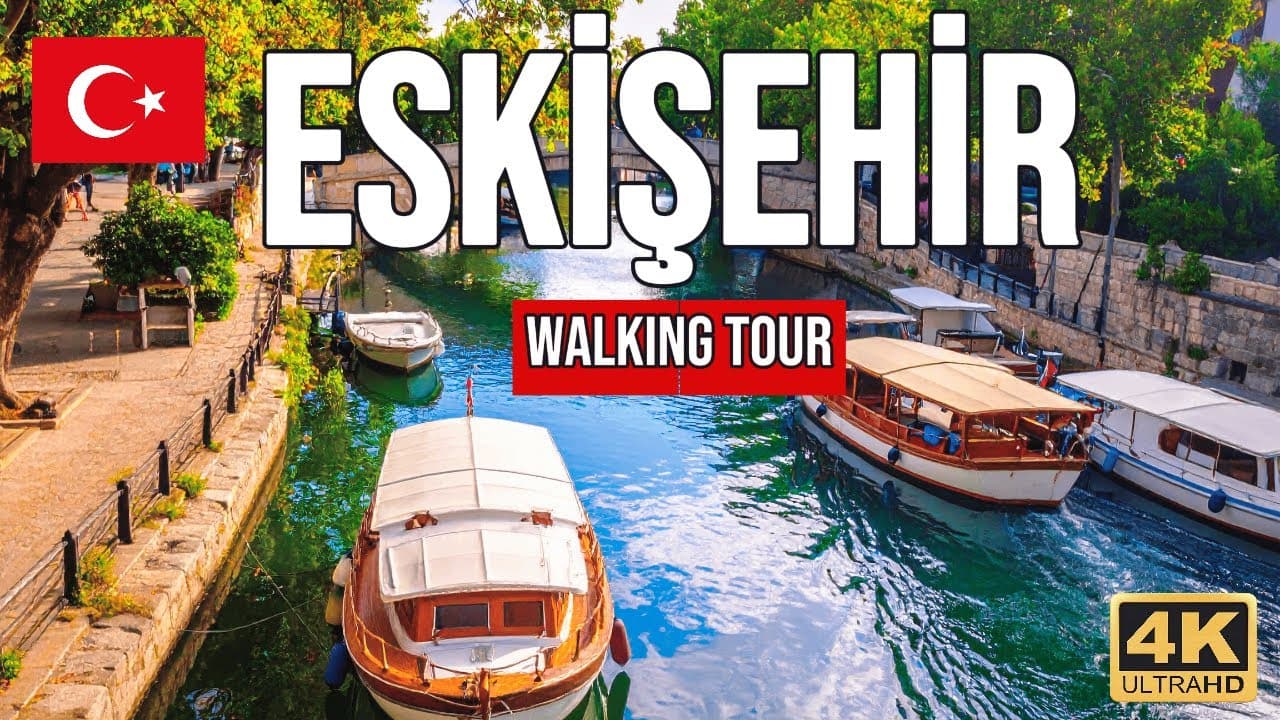
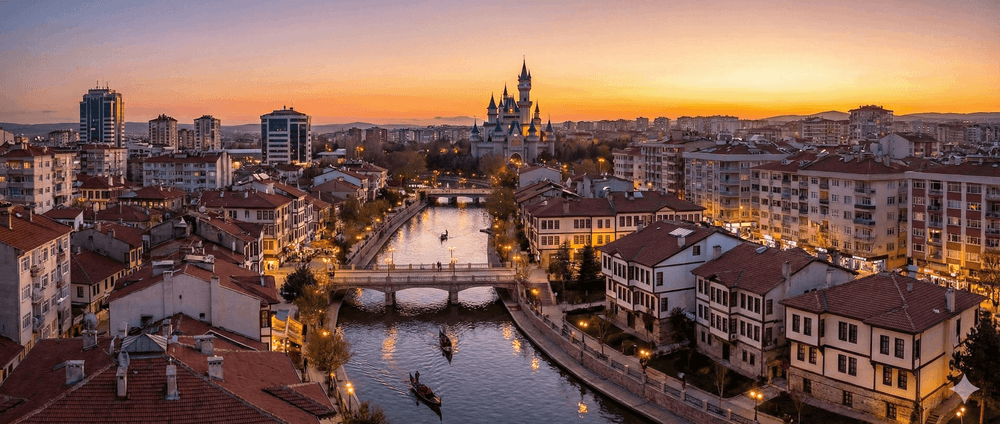
The Porsuk cuts the city in two, and Eskisehir's daily life largely happens along its banks. Bridges, walking paths and riverside cafes fill up in the late afternoon, and the gondolas and small boats give the city a look you will not find elsewhere in Turkey.
The gondola idea is borrowed from Venice and it is a gimmick. But the city has committed to it, locals ride too, nobody is pretending otherwise, and gliding under the bridges at water level is genuinely good fun. Length and price shift with the season, so ask at the dock.
Follow the bank east and you reach Kent Park, roughly 270,000 square metres running along the river, with a lake and an island. It is where locals walk in the evening, away from the central crush.
About the water itself, set expectations: through the centre the Porsuk is channelised, engineered and not remotely clear. The life on the banks is better than the river. Still, walking bridge to bridge is the shortest route to understanding this city.
7. Sazova Science, Culture and Arts Park
West of the centre is the city's largest park complex. Its best-known structure is the fairy-tale castle, a towered building that looks lifted from a cartoon and has become the park's emblem. Beside it sit a pirate-ship boat, a science centre, a zoo and wide walking grounds.
Bluntly, this is built for families, not for the adult traveller. The castle is not historic; it is an amusement set piece from the 2000s. Children adore it. An adult who came for architecture will shrug.
With kids, half a day passes easily, and the science centre and zoo hold their attention. Without kids, a short walk and a few photos are enough, and that time is probably better spent in Odunpazari.
One note on the zoo: the enclosures fall short of modern animal welfare standards, and visitors who feel strongly about such places may prefer to skip that section entirely.
The park is a few kilometres out, reached by tram or a short taxi. Entry is free; some attractions inside charge separately. Weekends are busy, weekdays calm.
8. Sarhoyuk (ancient Dorylaion)
Northeast of the centre is the mound where Dorylaion stood, the ancient ancestor of Eskisehir. What you see is not columns but a layered settlement hill and a working excavation, with Phrygian, Hellenistic, Roman, Byzantine and Ottoman traces stacked inside the same rise. Dorylaion appears in ancient sources for its hot springs and its position on the roads, and it mattered under Byzantium.
Set expectations immediately: this is not a stop for everyone. Do not look for a restored theatre or a visitor circuit. It is an active dig, what is visible depends on the excavation schedule, and it can be closed.
If archaeology interests you, four thousand years of one city compressed into a single hill is quietly impressive. If it does not, skip it without guilt; this is the easiest omission on the list.
One detail complicates the story pleasantly. The Battle of Dorylaeum of 1097 carries this name, but where it was actually fought is disputed and not identical with the mound.
Access is short by city bus or taxi. Confirm the site is open first.
9. Musaozu Nature Park
About 30 kilometres southwest of the centre, a nature park of pine woods around a reservoir. This is the classic spot locals drive out to for a weekend picnic and a walk.
It is not a natural wonder, and saying otherwise would be dishonest. A mid-sized body of water, trees, barbecue areas and walking tracks. But it is the right stop for understanding that Eskisehir sits on the edge of the Anatolian steppe, and where city people go when they want green.
If you are staying more than two days and want to give a morning to nothing in particular, it earns its place. If you only have a weekend, it belongs at the bottom of the list and you should feel fine about that.
On weekends and holidays the crowds and barbecue smoke get serious; go on a weekday for quiet. Driving is the practical way, since public transport is limited. As a designated nature park, access and use conditions can change, so check current official information first.
10. The Porsuk dam
The dam that feeds the river giving the city its character sits about 45 kilometres southwest of the centre: a wide body of water, hills around it, fish restaurants on the shore.
People come here as an escape rather than as sightseeing. For locals it means a weekend lunch and a view. For a traveller, the value is seeing what the Porsuk is before it becomes the tame, channelised thing running through town.
Without your own car this is awkward, and it probably will not top your list. But if you are driving south or towards the Phrygian side anyway, it makes sense as a stop near the route.
Water levels drop noticeably with the season and in dry years, so the lake you see in late summer can be considerably smaller than the spring version, with the shoreline visibly pulled back. This is a meal stop, not a destination; set expectations accordingly.
Whether the restaurants are open varies with the season, so confirm before you drive out.
11. The Great Mosque of Sivrihisar
The most important building in the province is not in the city. The Great Mosque of Sivrihisar sits about 100 kilometres east, and in 2023 it was inscribed on the UNESCO World Heritage List. This is not a tentative listing. At its 45th session the Committee adopted decision 45 COM 8B.46 and inscribed the property under criteria (ii) and (iv). The dossier number is 1694, the serial property is called the Wooden Hypostyle Mosques of Medieval Anatolia, and Sivrihisar is component 1694-003. The other four are the Great Mosque of Afyon, the Ahi Serefeddin (Arslanhane) Mosque in Ankara, the Mahmut Bey Mosque at Kasaba in Kastamonu, and the Esrefoglu Mosque in Beysehir.
Built in 1274-75, it looks unassuming outside: stone walls, a plain mass, nothing that announces itself. Step inside and the point lands. Rows of wooden posts rise to carry the roof, their capitals carved, the ceiling flat timber above them.
This structural system is particular to medieval Anatolia, and very few examples survive at this scale. The mosque is in active use, so mind prayer times.
12. The town of Sivrihisar
Driving out for the mosque and turning straight around would be a waste, because the town earns its own time. Sivrihisar is built at the foot of the pointed rock outcrops that give it its name, and they stand over the streets, giving the place an odd, hard backdrop.
Beyond the Great Mosque, other Seljuk and Ottoman buildings are scattered through the lanes: small mosques, tomb towers, bath houses, stone mansions. Some restored, some left to their fate. A small kilim museum and an open-air sculpture area sit in the centre.
Ninety minutes on foot covers it. Set expectations: this is a working district town, not a curated tourist village. Weekday afternoons can be very quiet, cafe options are limited, and some buildings will be locked.
A path climbs into the rocks, and from up there the roofs and the steppe appear together. The climb is short but steep, so avoid a hot midday.
Sivrihisar also had Armenian and Greek populations, and some of the stone fabric comes from that past. It is a layer the signage rarely mentions.
13. The village of Nasreddin Hoca (Hortu)
A village in the Sivrihisar district, formerly called Hortu and now officially named Nasreddin Hoca. Most sources accept that Nasreddin Hoca, the thirteenth-century folk figure whose stories are known across Turkey, the Balkans and Central Asia, was born here. Aksehir claims his grave.
Let us be direct: the village is small and unremarkable. There is a monument, a gravestone, some landscaping and a few things bearing his name. If you want visual reward, this is not your stop.
The value lies elsewhere. Turkish humour's most recognisable figure came out of an ordinary Central Anatolian village surrounded by fields, and that village is still exactly that. Seeing how little the fame brought home is its own kind of information.
The Nasreddin Hoca festival each July livens up Sivrihisar and the village. For the rest of the year it is very quiet indeed.
If you are already in Sivrihisar and have half an hour, go. Do not drive out from Eskisehir purely for this. A car is essential; public transport is not practical.
14. Pessinus (Ballihisar)
South of Sivrihisar, inside the village of Ballihisar, lies an ancient city that mattered enormously. Pessinus was among the principal centres of the cult of the mother goddess Cybele, and in 204 BC the Romans took the goddess's sacred stone from here to Rome. This village is the departure point of a piece of Roman religion.
What survives is modest: the steps of the temple terrace, a marble channel structure running through the site, scattered blocks. Village houses have grown into the excavation area and the two are thoroughly interleaved.
Calibrate your expectations, because this is not Ephesus. Nothing stands, interpretation is sparse, and reading the site takes some prior knowledge. If you visited the Eti Archaeology Museum first, it means a great deal more.
But standing at the centre of the Cybele cult and looking out at the surrounding steppe adds a strong second stop to a Sivrihisar day. Excavations have run for decades and the site is still not fully understood.
It is a short drive from Sivrihisar. Whether the area is open varies, so confirm first.
15. The Yunus Emre tomb (Mihaliccik)
In Yunusemre village in the Mihaliccik district stands a tomb claimed as the burial place of Yunus Emre, the thirteenth-century poet whose Turkish verse shaped the language of Anatolian mysticism.
Honesty is required here. More than ten places claim his grave and none is certain. Karaman, Aksaray and others make the same argument. Eskisehir's claim is among the older and better-supported ones, and the tomb and its surroundings have been developed accordingly, with a small museum alongside. The structure itself is new and carries no historic fabric.
Who it suits: anyone with a connection to Yunus Emre or an interest in Turkish mystical literature. Who it does not: anyone after architecture or scenery. Coming here is closer to a pilgrimage than a sightseeing stop, and you should set out knowing that.
The village is small with almost no services, so bring your own food and water.
It lies about 100 kilometres east and needs a car. Sivrihisar is also east but on a different line entirely; combining the two in one day takes longer than you expect. Plan it separately.
16. The Seyyid Battal Gazi complex
In the town of Seyitgazi, spread across the eastern slope of a hill, stands a complex founded in the name of Battal Gazi, an Umayyad-era warrior who died fighting Byzantium and grew into legend afterwards. It was built under the Seljuks and expanded with Ottoman additions.
The group takes in courtyards, tombs, a mosque, a madrasa and quarters given over to dervishes. Battal Gazi's tomb is the core, and beside it lies a second, outsized cenotaph that legend attaches to a Byzantine princess. The complex holds an important place in the Bektashi tradition and draws both Sunni and Alevi visitors.
It is visually strong too: thick stone walls, clustered domes, and a position looking down over the town.
What makes it worth the detour is what it shows about Anatolian syncretism, the way distinct layers of belief settle into the same building and stay there.
It sits about 45 kilometres south, on the road to the Phrygian side, so attaching it to your Midas Monument day is natural. Conditions and open sections vary; dress modestly at the tomb.
17. The Midas Monument (Yazilikaya)
The Phrygian highlands are shared between Eskisehir, Afyonkarahisar and Kutahya, and the heart of the Eskisehir share is Yazilikaya in the Han district. The Midas Monument is here: a vast Phrygian facade, roughly 17 metres high, carved into the living rock.
Dated between the eighth and sixth centuries BC, its surface is covered in geometric patterning, with Phrygian inscriptions linked to the cult of the mother goddess Matar. It is not a tomb but a cult facade, thought to have worked as an open-air shrine.
The inscriptions are not fully deciphered. Phrygian reads only partially, and "Midas" may be a title rather than a king, so the link to the golden-touch legend is thinner than the name suggests.
It is about 85 kilometres out. The roads are rural, signage is patchy, and public transport is not realistic. Your own car or a rental is the honest answer. Bring water and food; services are sparse.
In return, on most days, you stand in front of it alone. Almost nowhere else in Turkey does a monument of this scale give you that.
18. The Midas City acropolis
The plateau directly above the monument is the part most visitors skip, and the real story of the site is up there. Rock-cut stepped roads, cisterns, tunnel mouths, grain pits, and a second, unfinished monument facade.
Walking the whole thing can take more than an hour, and the ground is stony, so proper shoes matter. In midsummer there is next to no shade, so avoid the middle of the day.
Here is why it counts. The monument below is a single impressive surface; up here you see how an entire settlement was cut directly into the rock. The Phrygians did this by removing stone rather than stacking it, and the difference only registers once you are standing on top.
The unfinished facade is the most interesting thing on the plateau. A surface abandoned mid-work shows the carving sequence step by step, evidence that completed monuments simply cannot give you.
There are almost no railings or safety measures, so watch the edges, particularly with children. Coming this far and not walking up means missing half the visit.
19. The Gerdekkaya rock tomb
Near the village of Cukurca in the Seyitgazi district, a monumental tomb cut into rock. The facade carries a triangular pediment and two columns; behind it are two separate doorways and two burial chambers, with arched sarcophagi inside.
The dating is contested. The structure is generally considered Hellenistic, though its relationship to the Phrygian tradition is argued over, since the line of rock-working in this region does not separate cleanly by period.
The name evokes a bridal chamber, which is a common folk label for rock monuments of this kind. There is more than one Gerdekkaya in Anatolia, so do not confuse them.
This is a small stop and half an hour covers it. The monument is neglected, with names scratched into it, and its state of preservation is not good. Seeing that is mildly depressing.
If you are travelling between Seyitgazi and Han it is a sensible waypoint, sitting directly on the route. The road is rural and the final stretch can be unsurfaced; ask about conditions in bad weather and do not push a low car down it.
20. Pismis Kale
North of Yazilikaya, a Phrygian rock fortress built on top of a mass of stone that commands everything around it. Cut steps, hollows and traces of fortification are still legible in the rock.
Very few visitors come here, which is the good news. No crowds, no ticket booth, and no facilities either. The path up is not obvious and the last stretch needs care; it gets slippery when wet. If you are going alone, tell someone.
The view from the top explains what the Phrygian highlands actually look like in a single frame: rolling steppe, tuff masses rising abruptly out of it, fields in between. It also explains instantly why the fortress was put here, since every approach road is visible from above.
Where the name comes from is unclear, though some link it to the baked-earth colour of the rock.
If you have seen the Midas Monument and still have time and energy, climb up. If not, skip it with a clear conscience. This is not a compulsory stop and your Phrygian day is complete without it.
Getting there
The high-speed train is the practical answer. The YHT line links the city to Istanbul and Ankara: about ninety minutes from Ankara, roughly three hours from Istanbul, with the station within walking distance of the centre. Check TCDD channels for times and tickets, as weekend trains sell out early.
Buses run regularly from many cities, and the terminal connects to the centre by tram. Eskisehir has an airport with limited flights, but the train is easier for most visitors.
In town, the centre walks: Odunpazari, the museums and the riverside sit close together, and the tram handles longer hops like Sazova.
The real problem is everything outside. Buses reach Sivrihisar, but the timetables constrain you. For the Phrygian side, Seyitgazi and Yunusemre, public transport is not realistic. A rental car or a day tour are the sensible options. Verify routes and whether sites are open before setting out.
How many days
One full day: Odunpazari, the museums, the riverside. You have seen the city.
Two days: the centre, then the Great Mosque of Sivrihisar and the town, with Pessinus added if you want. This is the best-balanced weekend.
Three days: give the third to the Phrygian side. The Seyyid Battal Gazi complex, Gerdekkaya, the Midas Monument and the acropolis. That day wants a car and an early start.
Four or more adds Musaozu, the Porsuk dam and Yunusemre. For most travellers that is more Eskisehir than anyone needs.
When to go
Spring and autumn are the easiest seasons. April to June and September to October is the right window for both city walking and the Phrygian trip.
Summer days get hot. The riverside cools in the evening, but on the shadeless steppe of the Phrygian side, midday heat is a genuine problem. Start early.
Winter is cold and snowy. The painted houses of Odunpazari do look good under snow. But the rural roads on the Phrygian side get difficult and some sites become effectively unreachable, so a winter trip should be built around the centre and Sivrihisar.
Term time keeps the city lively. In the summer holidays the centre quietens, which helps if you dislike crowds and hurts if you came for the atmosphere.
What to eat
Above everything else is ciborek. Thin dough filled with a little minced meat and onion, then fried. It came here with Crimean Tatar settlers and has become the city's signature. Eaten hot, by hand, with ayran as the standard companion. Locals say "ciborek", though you will see signs reading "cig borek". One is never enough for anyone.
The second classic is met halva, a hand-pulled flour halva that dissolves into threads in the mouth. Sold boxed, which makes it a practical thing to carry home.
Beyond those, try balaban tava, a lamb dish, and the other pastries of the Tatar kitchen. The area around Odunpazari and the small restaurants in the centre are the right ground for all of it. Hanimeli Street, a short lane of food stalls and craft tables, is in the centre north of the river, not in Odunpazari as is often written.
Frequently asked questions
**Is there a UNESCO World Heritage Site in Eskisehir?** Yes. The Great Mosque of Sivrihisar was inscribed in 2023 at the Committee's 45th session by decision 45 COM 8B.46, under criteria (ii) and (iv). It is component 1694-003 of the five-part serial property Wooden Hypostyle Mosques of Medieval Anatolia (dossier 1694). Odunpazari has been on the tentative list since 2012, but a tentative listing is not an inscription.
**How many days do you need?** One full day for the centre. Two if you add Sivrihisar, three if you want the Phrygian side as well.
**Can you reach the Phrygian Valley without a car?** Realistically, no. Public transport to the Han district is inadequate. A rental car or a day tour are the workable options.
**Are these the same Phrygian sites as in the Afyon guide?** No. The Phrygian highlands are split across three provinces. Ayazini, Goynus and Aslankaya are on the Afyon side; the Midas Monument, Pismis Kale and Gerdekkaya are on the Eskisehir side. Combining the two in one day is difficult.
**Are the Odunpazari houses actually historic?** The fabric and the buildings are genuine, but the colours are largely a restoration choice and brighter than the natural tone of the original timber. The quarter is criticised for it. It remains one of the best-preserved Ottoman domestic streetscapes in Turkey.
Planning questions
What does this Eskişehir guide cover?
Plan Eskisehir around the colourful Odunpazari houses, the Porsuk river and gondolas, the museums, Ozgurluk hill and the Phrygian Valley.
Can I watch a 4K walking tour of Eskişehir?
Yes. The page links to Travel Walk Tours films so you can preview the Eskişehir route on a big screen before you go.
How should I use this page to plan?
Read the quick answer first, skim the route notes, then compare street texture, timing, and nearby guides through the linked city page and walking films.