Plan Taksim and Istiklal Avenue around the square, the passages, the fish market and the Pera Museum, with crowd and practical notes.
Walk this route
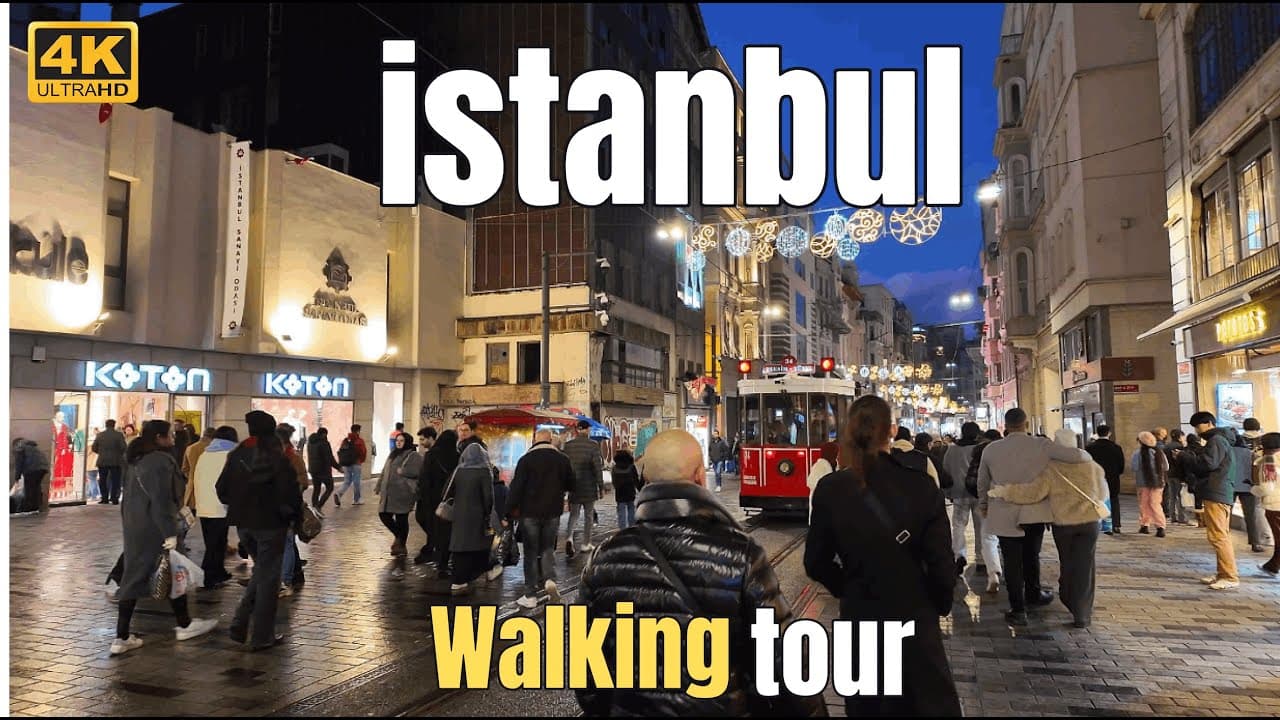
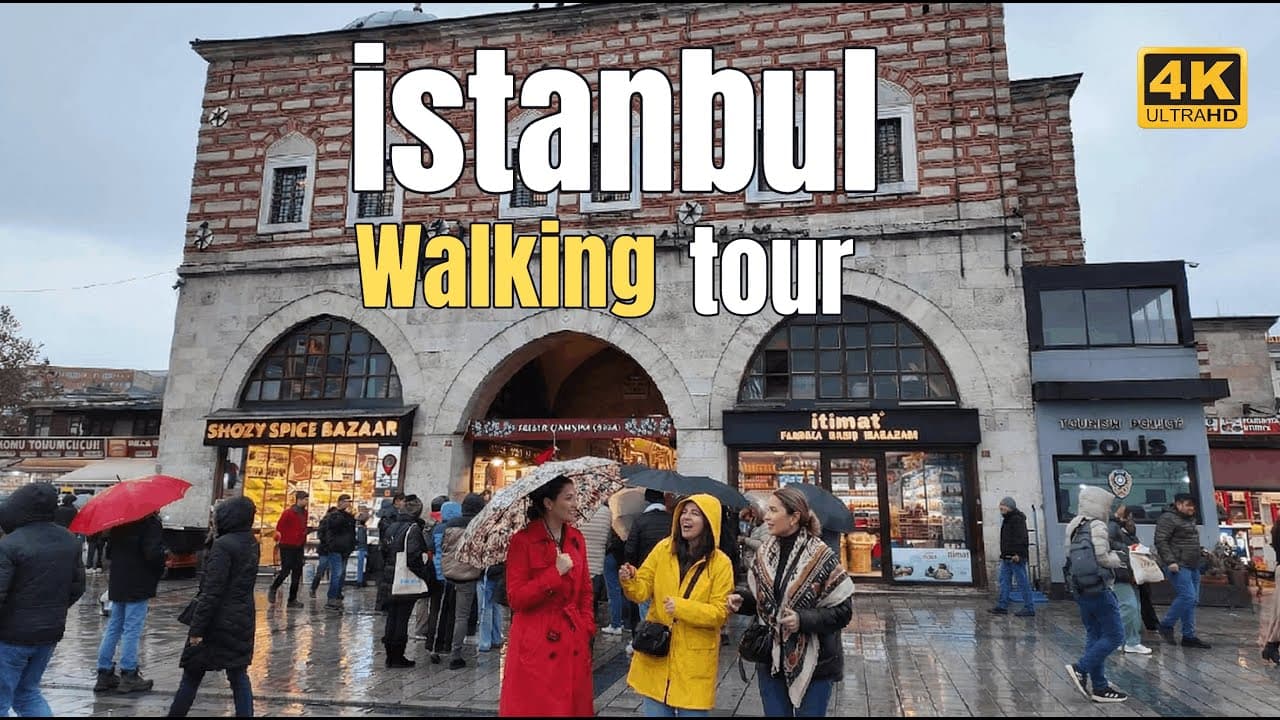
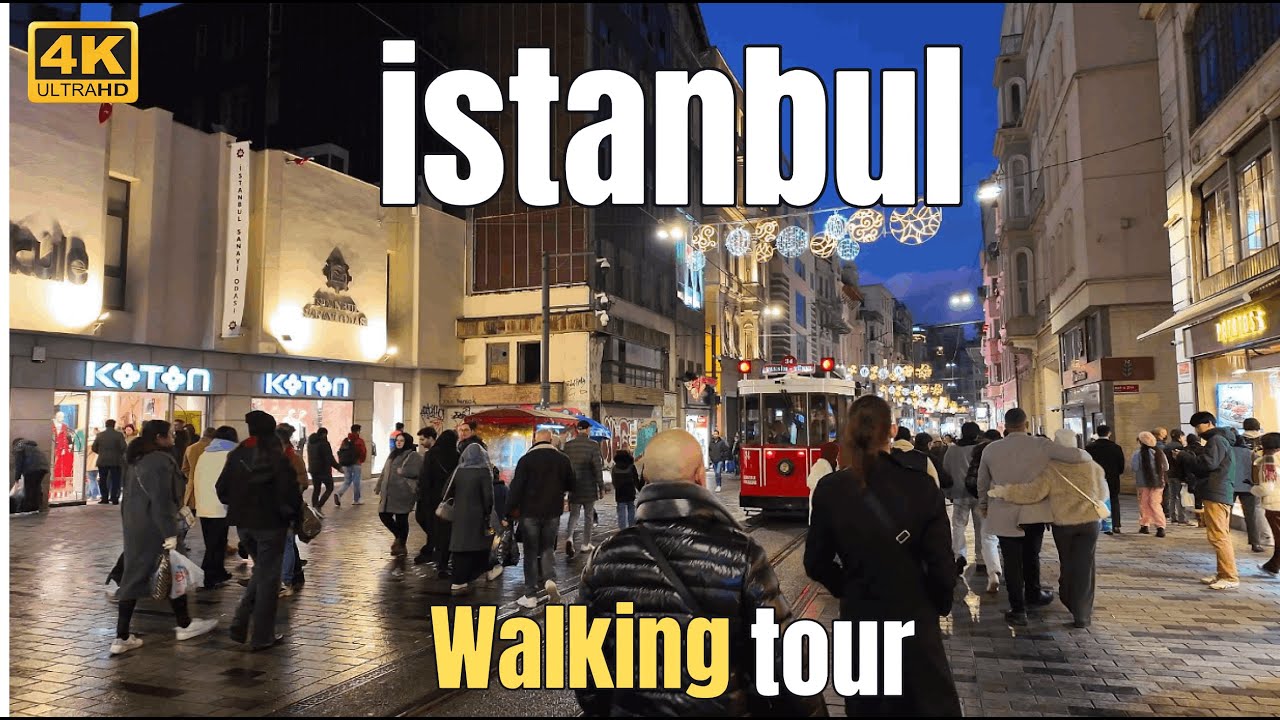
Istanbul Walking Tour 4K - Evening Walk on Istiklal Street & Taksim Square
Watch the 4K walkPlaces on the map
12 pinsNumbers match the order in the article. Tap a pin for directions.
Taksim and Istiklal: the crowded spine of Beyoglu
İstiklal Avenue runs 1.4 kilometres from Taksim Square down to Tünel, and for more than a century it has been the city's promenade: the old Grande Rue de Péra of embassies and department stores, now a river of people flowing past arcades, churches, cinemas and a little red tram. Whatever Istanbul is feeling on a given evening, it is feeling it here first.
The avenue rewards and punishes in equal measure. Walked end to end in the crowd, head down, it is just noise and shopfronts. Stepped through slowly, with detours into the passages, the fish market and the museum lobbies, it is the densest slice of late-Ottoman and Republican culture in the city.
That is the common mistake to avoid: İstiklal is not a walk, it is a string of doors. This guide opens twelve of them, from the square at the top to the hotel where the Orient Express set drank.
Quick answer
Taksim-İstiklal is Istanbul's main pedestrian avenue and entertainment spine, best explored through its side doors: passages, the fish market, churches and museums.
- Come on a weekday morning for space, or in the evening for the meyhane life; weekend afternoons are shoulder to shoulder.
- Keep wallets and phones zipped in the crowd, and check menu prices in Nevizade before sitting.
- The M2 metro and the funicular land you at Taksim; the nostalgic tram or your feet do the rest.
1. Taksim Square and the Republic Monument
Taksim is where Istanbul gathers: for celebration, for protest, for New Year and for match nights. The name comes from the Ottoman stone water-distribution house still standing at the square's edge, but the centrepiece is the Republic Monument of 1928, with Atatürk and the founding generation cast in bronze on both faces, one side for the War of Independence, one for the Republic. The square itself is a wide, hard plain, more crossroads than beauty spot, ringed by the AKM, the mosque of 2021 and the head of İstiklal. Treat it as the starting gun rather than the destination: orient yourself by the monument, note the metro entrances for later, and walk into the avenue. Early morning is the only time you will see it near empty.
2. Gezi Park
Directly above the square lies Gezi Park, a modest rectangle of plane trees and benches that happens to be the most famous small park in Turkey. Laid out in the 1940s over a demolished Ottoman barracks, it offers the only real shade and quiet within reach of Taksim: office workers with tea, families on the grass slopes, cats being fed. As a visitor you need fifteen minutes here at most, but on a hot afternoon those fifteen minutes matter, and the raised terrace at the square end gives a useful overview of Taksim's whole choreography. The park closes for events occasionally and is best in daylight hours; at night stick to the lit main paths as you would in any city-centre park.
3. Istiklal Avenue
The avenue itself deserves reading as a building catalogue: art nouveau apartment palaces, arcaded rows from the 1870s, consulates that were embassies when this was the diplomatic street of an empire. The nostalgic red tram trundles the full length between Taksim and Tünel, using the standard transit card; it is slower than walking when the crowd is thick, but riding it once is part of the ritual. Shops churn constantly, global brands at street level, older workshops and rooftop bars surviving upstairs. Walk one direction and tram the other. Pickpocketing is the avenue's one real hazard, worst in the densest evening flow: bags closed and in front, phones out of back pockets. Every remaining stop in this guide opens directly off this line.
4. Cicek Pasaji
The Cité de Péra, universally known as Çiçek Pasajı, the Flower Passage, went up in 1876 as the avenue's grandest arcade, a curved gallery of caryatids and globe lamps. Flower sellers filled it between the wars, then the meyhanes moved in, and today its barrel-vaulted lane is a single row of white-tablecloth tavern terraces. Honest assessment: it is now more photographed than eaten in, and the neighbouring lanes serve better food for less. But the architecture is genuinely splendid, restored to its gilded best, and walking its length costs nothing. If you do sit down, confirm prices before ordering, especially for fish and rakı. The passage connects İstiklal to the fish market behind it, which is the natural next step.
5. The fish market and Nevizade
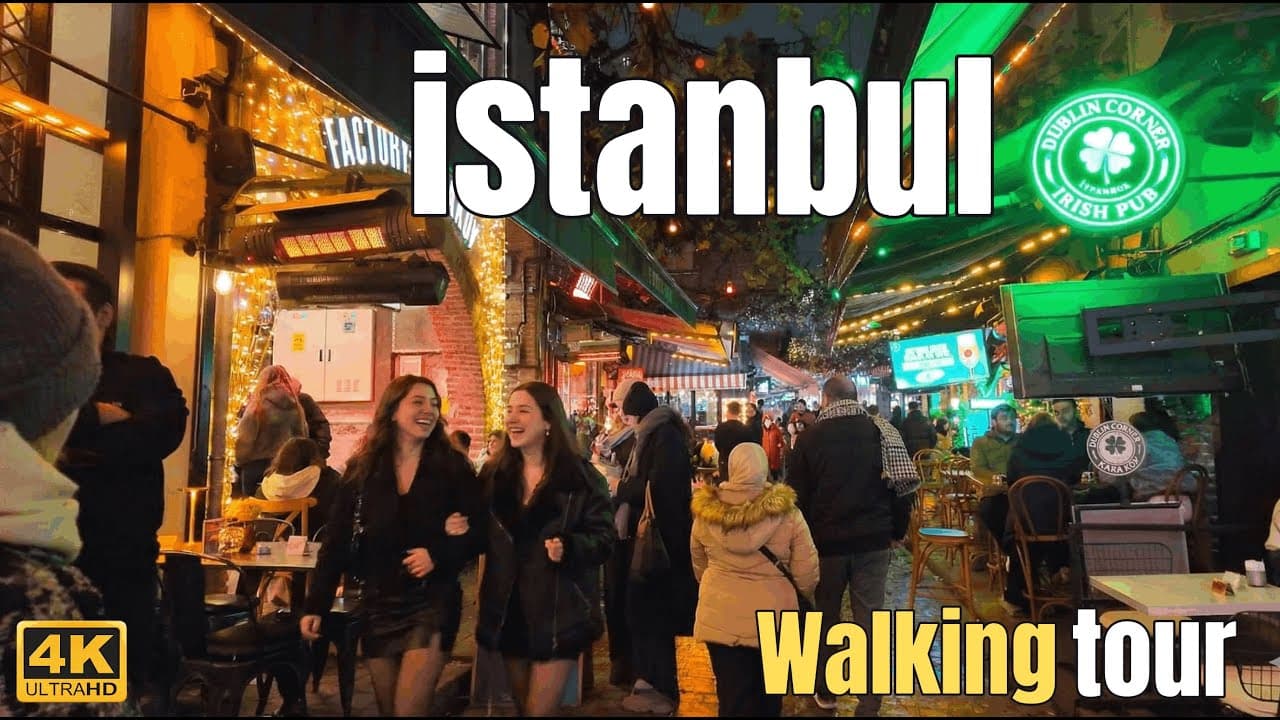
Behind Çiçek Pasajı runs the Balık Pazarı, the Galatasaray fish market: a lane of iced counters, midye tezgahları selling stuffed mussels by the piece, pickle shops and kokoreç grills. Push through it and turn into Nevizade Sokak, the densest meyhane street in the city, where tables from rival taverns interlock so tightly the waiters need choreography. Evenings here are the classic Beyoğlu night: cold meze, grilled fish, rakı and rising noise. The tourist premium is real; ask for the menu with prices, agree fish prices by weight before cooking, and count the meze plates you accepted. Weeknights are calmer than Friday and Saturday. The market itself is best in daytime, the street after dark: two visits hiding in one address.
6. Galatasaray Square and the lycee
Halfway down, the avenue widens at Galatasaray Meydanı, marked by the monumental gate of Galatasaray Lisesi, the French-language imperial school founded on this site in 1481 and rebuilt in its present form in the early 20th century. The school is closed to visitors, but the gate, the plane trees behind the railings and the pale neoclassical facade give the avenue its most dignified pause. The square doubles as the avenue's unofficial civic forum and its central landmark for meeting people. Around it cluster the entrances to several historic passages, the fish market and the downhill lane to Çukurcuma's antique shops. From here it is roughly ten minutes' walk to either end of İstiklal, which makes it the hinge of any route you plan.
7. Atlas Pasaji and the historic arcades
İstiklal's arcades are its secret floor plan, and Atlas Pasajı is the one to enter first: a high iron-and-glass gallery of 1870 whose cinema became a landmark of Turkish film culture and now houses the state Cinema Museum alongside the restored Atlas movie theatre. Around it, each passage keeps a different trade: Halep Pasajı with its old theatre, Hazzopulo with its courtyard tea tables reached through a stone tunnel, Terkos and Aznavur with vintage clothes, records and trinkets. None takes more than ten minutes, all are free to wander, and together they explain what the avenue was before the chain stores: a chain of small interior worlds. Museum hours and exhibitions change, so verify the Cinema Museum's schedule officially if it matters to your day.
8. St. Anthony's Church
The largest Catholic church in Istanbul stands back from the avenue behind a brick forecourt: St. Antuan, finished in 1912 in red neo-gothic, Venetian in flavour because it served the Italian community of Pera. Angelo Roncalli, later Pope John XXIII, preached here in the 1930s and is remembered fondly as the Turkish Pope. The church is open to visitors daily and remains fully active, with Mass in several languages; enter quietly, dress reasonably, avoid wandering during services. The interior is tall, calm and cool, a genuine sanctuary three steps off the avenue's noise, and the contrast is the point: Pera was always a layered city of Catholics, Orthodox, Jews and Muslims sharing one street. Donations rather than tickets; verify Mass times on the parish's official pages if you wish to attend.
9. The Pera Museum
Just below the avenue on Meşrutiyet Street, the Pera Museum occupies the marble shell of the 1893 Bristol Hotel and holds the painting every Turkish schoolchild knows: Osman Hamdi Bey's The Tortoise Trainer. Around it, the Orientalist painting collection shows Europe and the Ottoman world staring at each other across two centuries, and the Anatolian weights-and-measures and Kütahya tile collections fill the lower floors. The upper storeys rotate serious international exhibitions. It is a compact museum, ninety minutes at a comfortable pace, air-conditioned and rarely crowded on weekday mornings. There are student, senior and free-day arrangements that change, so verify hours and tickets officially. Combined with the arcades and St. Anthony's, it makes the cultural counterweight to the avenue's shopping.
10. The Pera Palace Hotel
Two minutes further along Meşrutiyet stands the Pera Palace, built in 1895 so Orient Express passengers could end the journey from Paris in appropriate style. The guest list wrote the hotel's marketing forever: Agatha Christie, whose room is kept in period, Greta Garbo, Hemingway, and Atatürk, whose room 101 is preserved as a small museum, viewable on request subject to the hotel's arrangements. You do not need a room to visit: the domed Kubbeli Saloon serves afternoon tea beneath restored Orientalist splendour, and the historic birdcage lift still runs. Prices match the chandeliers, so treat it as a sight with optional tea rather than a budget stop. Verify museum-room access and tea hours officially; smart-casual dress fits the room.
11. The Ataturk Cultural Centre (AKM)
Closing the square's eastern side stands the AKM, the Republic's flagship opera house, demolished and rebuilt in 2021 with its modernist grid facade restored and a giant red sphere of an auditorium inside the glass hall. By day you can walk the public galleries, the design shop and the cafes and look down into the foyer; by night it runs opera, ballet, symphony and exhibitions at prices deliberately kept accessible. If your evening is free, checking the AKM programme is the single best cultural bet around Taksim; tickets for popular productions go early, so book through the official system. Even without a performance, the building is the square's one interior worth entering, and its terrace frames the monument and the mosque in a single view.
12. The Tarlabasi edge and the side streets
The blocks falling away northwest of the avenue belong to Tarlabaşı, the old Greek and Armenian tenement quarter that spent decades as the city's byword for decay and is now a patchwork of demolition, renovation and stubborn everyday life. The architecture, bay-windowed row houses leaning over narrow lanes, is some of the finest domestic building Pera ever produced, and glimpses from the boulevard's edge show it honestly. Practical advice without drama: this remains a poor, dense neighbourhood in transition; explore in daylight, stay on the main lanes, keep cameras low-key and valuables out of sight. For most visitors the right dose is the view down the side streets from the İstiklal edge, which tells the story clearly enough: the avenue was always a thin gilded line with a harder city behind it.
Getting there
Taksim is one of the city's main transit hubs: the M2 metro from Şişhane, Vezneciler or Levent; the F1 funicular up from Kabataş, where the T1 tram and the Dolmabahçe shore connect; and buses from everywhere. For the avenue itself, start at either end: Taksim (metro) or Tünel, reached by the 1875 Tünel funicular from Karaköy. The nostalgic tram links the two ends along the surface. On foot, Galata and Cihangir are each ten minutes' walk from mid-avenue.
When to go
Weekday mornings show the architecture; the crowd owns everything after mid-afternoon. Friday and Saturday evenings are the meyhane peak, loud and cheerful, with Nevizade tables gone by nine. Sunday morning is the emptiest the avenue ever gets and the best light for photographs. Big events at Taksim occasionally close the square and flood the metro; if you hit one, walk down to Karaköy instead of fighting for the funicular.
Eating and drinking
The axis feeds every budget: simit and wet burgers at the Taksim end, künefe and kokoreç in the fish market, patisserie survivals from Pera's café age along the avenue, and the full meze-and-rakı theatre of Nevizade after dark. Two habits protect your bill: confirm prices on a written menu before sitting, and agree fish by weight and price before it goes to the grill. Third-wave coffee hides in the passages and down toward Cihangir; historic pastry shops cluster near Galatasaray.
Frequently asked questions
How long does Istiklal take?
End to end is a twenty-minute walk with no stops, but that misses the point. With passages, the fish market, a museum and a tea stop, plan half a day; add the evening for Nevizade.
Is Taksim safe?
The avenue and square are heavily used and policed at all hours; the practical risks are pickpocketing in crowds and inflated bills at pushy venues. Side streets toward Tarlabaşı are for daylight; toward Cihangir and Galata they are fine into the night.
Is the nostalgic tram worth it?
As transport, no; it is slower than walking when crowded. As a five-minute ritual with standard transit fare, yes, once, ideally from Tünel uphill.
Where does this area connect next?
Tünel drops you into Galata's tower quarter; Galatasaray's downhill lanes lead to Çukurcuma and Cihangir; and Kabataş funicular links to the Dolmabahçe shore. Each of those has its own guide.
Planning questions
What does this İstanbul guide cover?
Plan Taksim and Istiklal Avenue around the square, the passages, the fish market and the Pera Museum, with crowd and practical notes.
Can I watch a 4K walking tour of İstanbul?
Yes. The page links to Travel Walk Tours films so you can preview the İstanbul route on a big screen before you go.
How should I use this page to plan?
Read the quick answer first, skim the route notes, then compare street texture, timing, and nearby guides through the linked city page and walking films.